
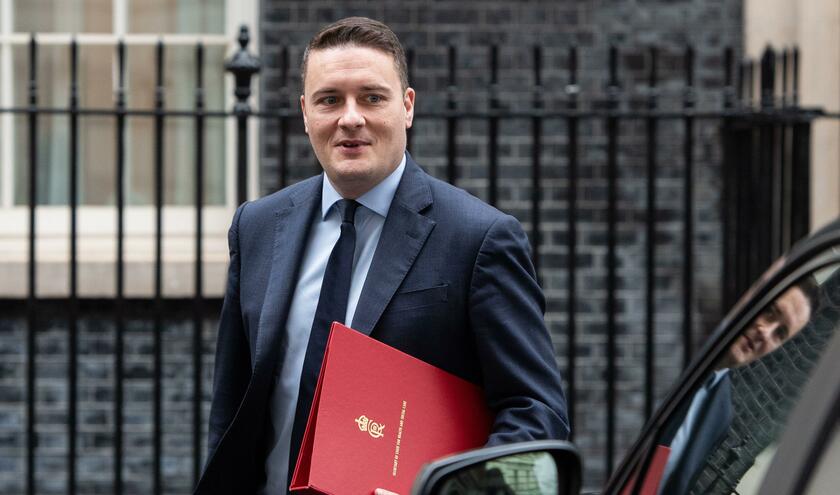
Muslim Census survey finds Andy Burnham is the only leadership contender who could retain and grow Muslim support, as Labour’s relationship with the Muslim community continues its struggles.
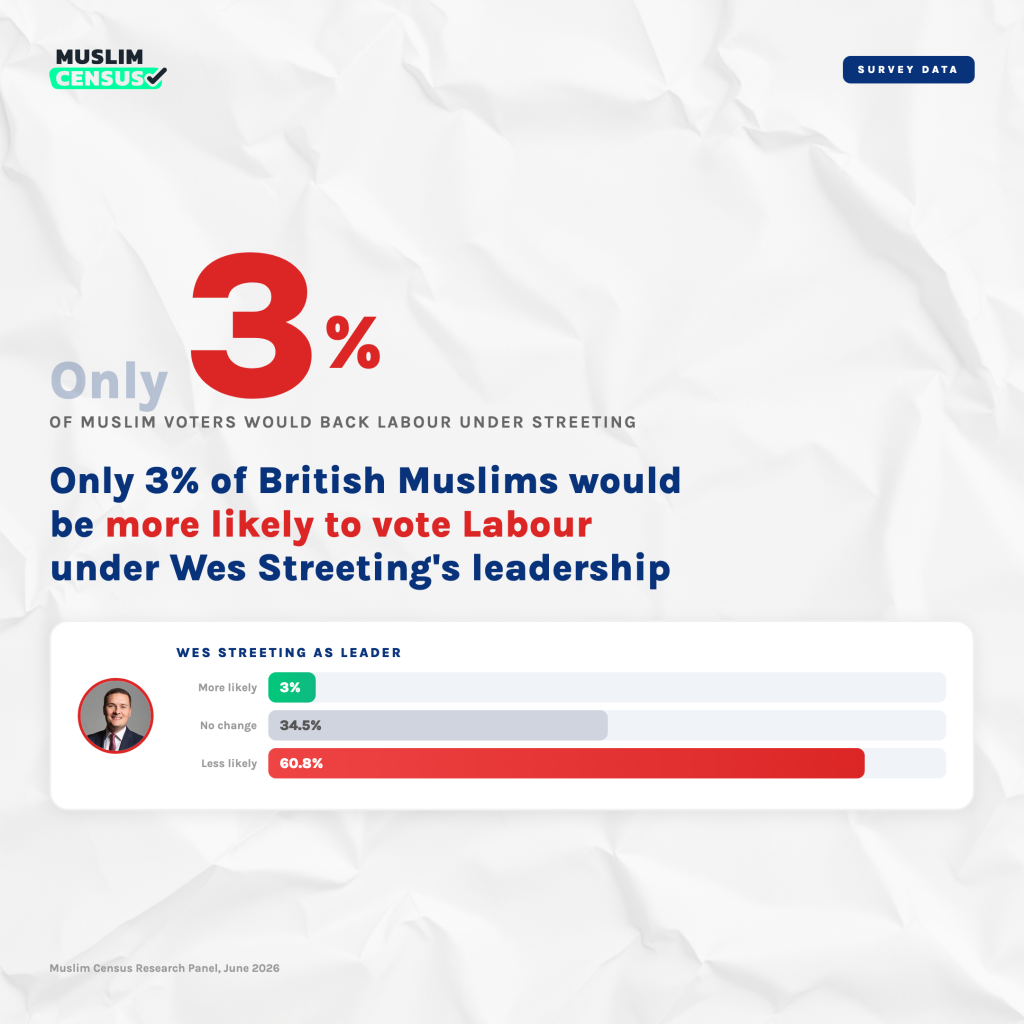
Labour’s crisis with Muslim voters shows little sign of recovery. New data from the Muslim Census Research Panel reveals that just 3% of British Muslims would be more likely to vote Labour if Wes Streeting became party leader, while almost two thirds said they would be even less likely to support the party under his leadership.
The findings come at a critical moment for Labour. With Keir Starmer’s net favourability at -46% according to Statista, and speculation growing over the party’s direction, the question of who leads Labour next could determine whether the party has any chance of rebuilding trust with Muslim communities.
From 85% to 7%: The Collapse of Labour’s Muslim Vote
The scale of Labour’s decline among Muslim voters is without precedent. In the 2017 general election, 85% of Muslims who voted backed Labour, according to the British Religion in Numbers project. A Survation poll conducted for the Labour Muslim Network put the figure at 86% in 2019.
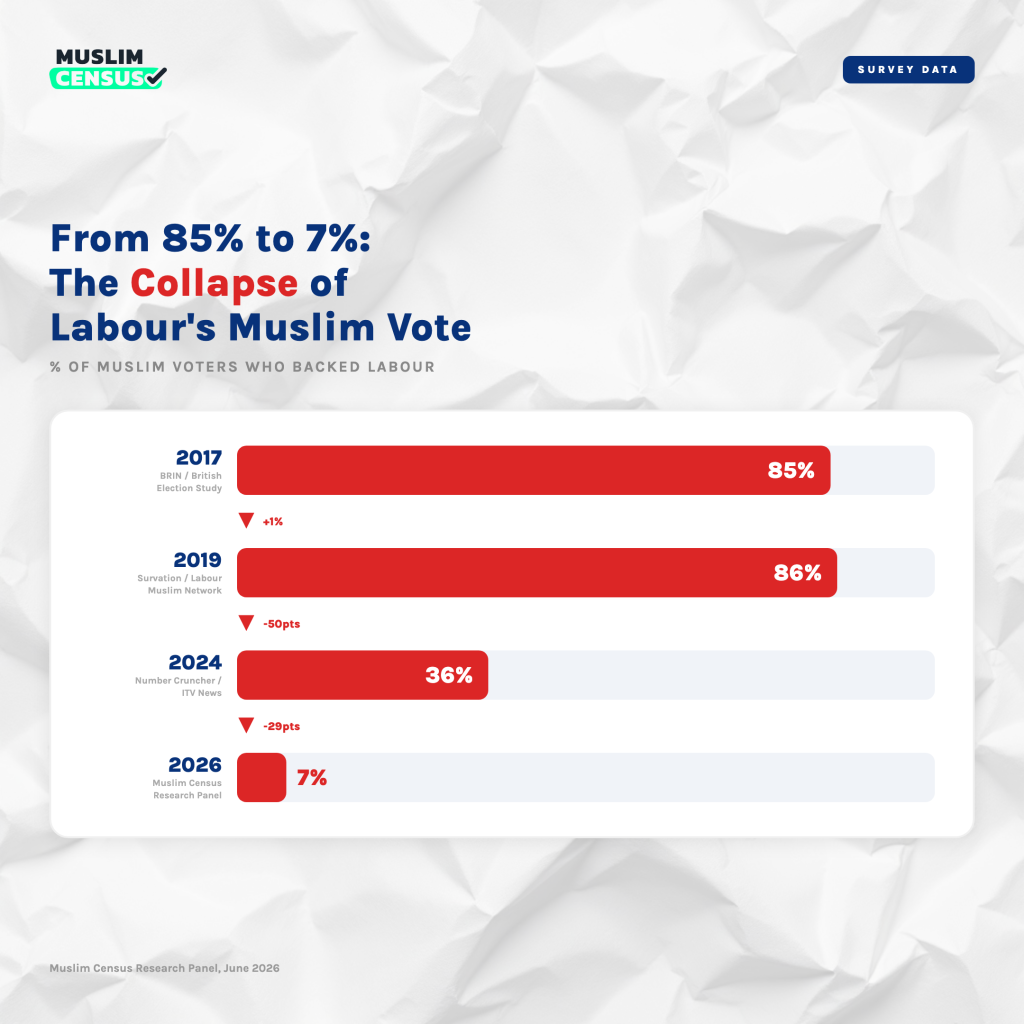
By the 2024 general election, that support had fallen to approximately 63%, according to a Savanta poll for Hyphen. In heavily Muslim constituencies, the damage was far worse. Analysis by Number Cruncher Politics for ITV News found Labour lost 33 percentage points in majority-Muslim areas, with vote share in the 21 seats where more than 30% of the population is Muslim falling from 65% to just 36%.
The consequences were immediate. Labour lost five seats to pro-Gaza independent candidates, including Leicester South, where Shadow Cabinet member Jonathan Ashworth was defeated by independent Shockat Adam, who declared “this is for Gaza” upon winning.
In our own survey of the May 2026 council elections, just 7% of Muslim respondents said they voted Labour. The Green Party was the most popular choice at 36%, followed by independent candidates at 17%. Not a single respondent reported voting Conservative or Reform UK.
Wes Streeting: A Leadership That Would Accelerate the Decline
The survey asked respondents how their likelihood of voting Labour would change under potential new leaders, excluding those who answered “not sure” to focus on decided voters.
The results for Wes Streeting are stark. Only 3% said they would be more likely to vote Labour under his leadership. 34.5% said it would make no difference. And 60.8%, almost two thirds, said they would be even less likely to support the party.
Streeting’s relationship with Muslim communities has been complicated. In the 2024 general election, he survived in Ilford North by just 528 votes against British-Palestinian independent candidate Leanne Mohamad. His majority collapsed from approximately 5,000 in 2019 as The Muslim Vote campaign mobilised against him.
Text messages to Peter Mandelson leaked in February 2026, reported by The Jewish Chronicle, revealed Streeting had privately acknowledged that Israel was “committing war crimes before our eyes” and endorsed sanctions, while publicly maintaining a more cautious position. For many Muslim voters, the gap between private acknowledgement and public action has deepened the sense of distrust.
These findings suggest that a Streeting-led Labour Party would not simply fail to recover Muslim support. It would actively drive it further away.
Andy Burnham: The Only Option That Could Gain Muslim Support?
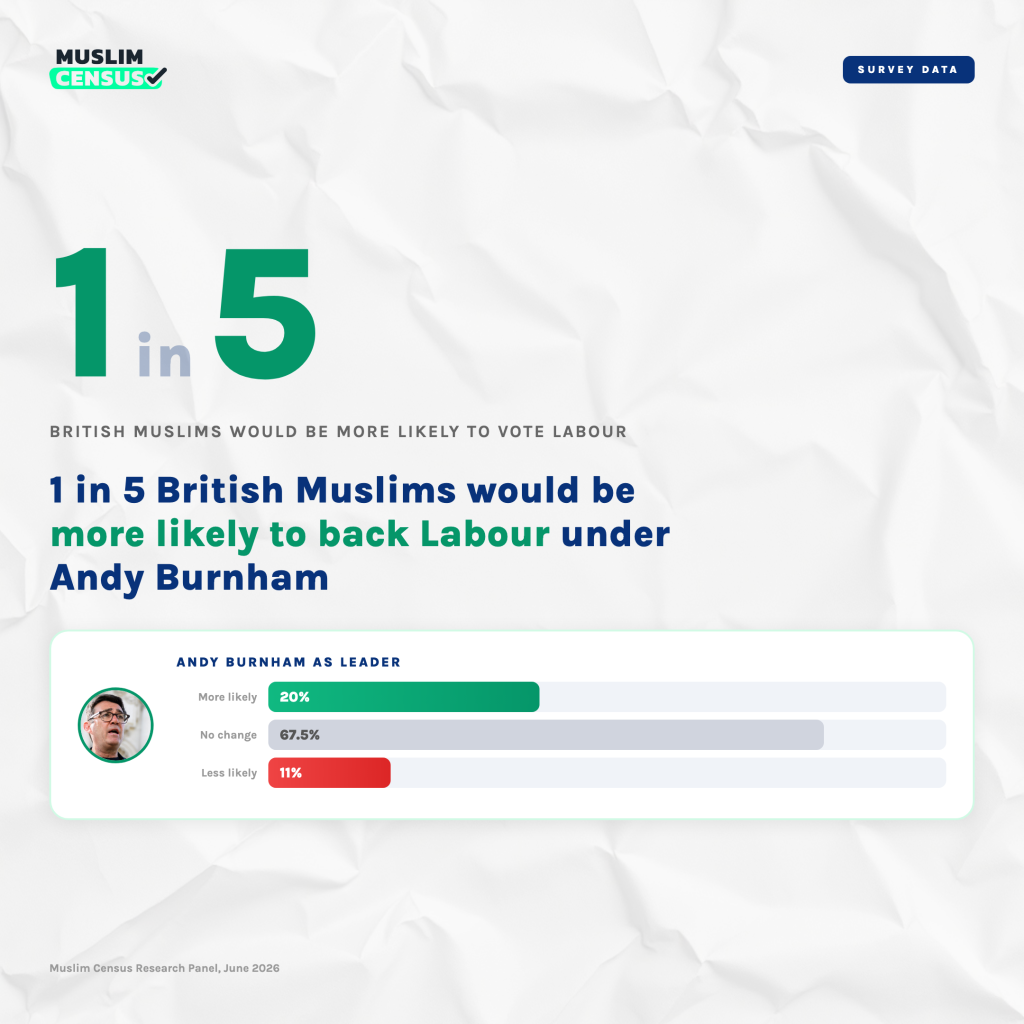
The picture for Andy Burnham is markedly different. One in five respondents, 20%, said they would be more likely to vote Labour under his leadership. 67.5% said it would make no difference, and just 11% said they would be less likely to support the party.
Burnham, the Mayor of Greater Manchester, has distinguished himself from the party’s national leadership on several issues that resonate with Muslim communities. In late October 2023, he broke ranks with Starmer by calling for an immediate ceasefire in Gaza alongside London Mayor Sadiq Khan and Scottish Labour leader Anas Sarwar.
His standing with Muslim communities extends beyond the conflict in Gaza. The president of Manchester Central Mosque stated he had “nothing but praise” for Burnham, according to Hyphen, citing his role in securing PPE for mosques providing burial services during the pandemic. MEND, one of the UK’s leading Muslim advocacy organisations, organised a roundtable with Burnham bringing together over 30 mosques and more than 70 community representatives. And his response during the summer 2024 far-right riots, which included an attempted attack on Manchester Central Mosque, was widely praised by local Muslim leaders.
YouGov polling has found Burnham is the top choice for Labour leader among party members, with 59% saying they would back him over Starmer.
It is worth noting, however, that the majority of Muslim respondents in our survey, 67.5%, said Burnham’s leadership would make no difference to their voting intention. The damage to Labour’s relationship with Muslim communities runs deeper than any single leader. For most, the issue is not simply who leads the party but what it has come to represent.
What This Means for Labour
The data presents Labour with a clear choice. Under Wes Streeting, the party would face a near-total collapse of Muslim support, losing voters it can ill afford to lose in dozens of marginal seats across the Midlands, the North and London. Under Andy Burnham, there is at least a foundation to build on, though rebuilding trust will require far more than a change of leader.
What is no longer in question is that the Muslim vote, once among the most reliable in Labour’s coalition, has gone. Whether it can be won back depends entirely on what happens next.
About the Research
This survey was conducted through the Muslim Census Research Panel in May and June 2026, with 111 responses. The panel is a dedicated research platform for British Muslims. Respondents were asked how their likelihood of voting Labour would change under each potential leader. Percentages cited in this article exclude “not sure” responses to reflect the views of decided voters.
For access to the full dataset, further analysis or media enquiries, please contact the Muslim Census team here.